Welcome back to The Racket Report Monthly. In this month's edition, we'll be discussing:
The new Wilson everyone is asking about, and what is actually in it
Why you should check your grip this week
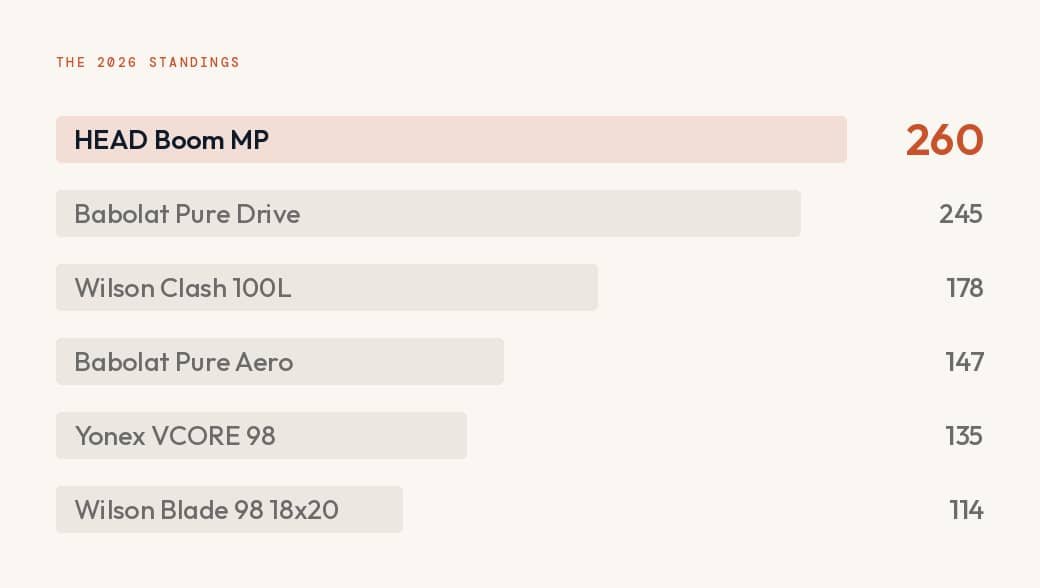
The 2026 racket standings
First, something you might have lost track of:
Your personal fitting report - Your rackets, strings, exact tension, and the reasoning behind all of it:
Your fitting report is still here. It doesn't expire. It arrived by email right after your fitting. Lost it? Retake your fitting at perfectracket.com and you'll get a fresh one.
This Month In Tennis
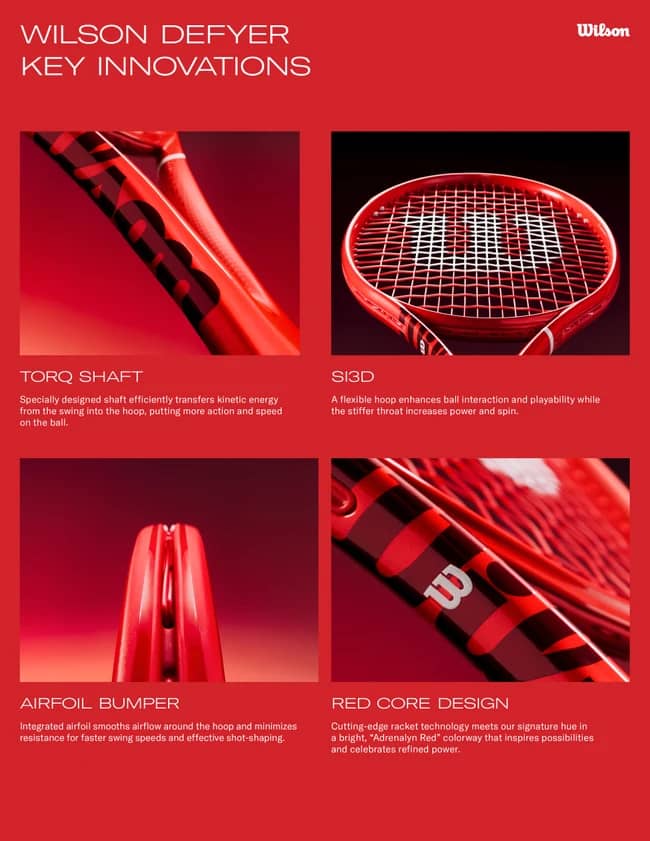
The Defyer is the racket everyone is asking about.
Wilson Defyer Key Innovations (Courtesy of Wilson)
Wilson's Defyer turned up on the Lincoln Challenger racket board we showed you in issue one. The version people keep asking about is the 98 Pro. Here is what is actually in it:
98 square inch head
305 g unstrung
323 swingweight
RA 65
16x20 string pattern
22 / 23.5 / 22 mm beam
6 points head light
Now put that next to the two 98s most people already know. A Yonex VCORE 98 is 305 g and swings at 320. A Yonex EZONE 98 is 305 g and swings at 330. The Defyer sits right between them at 323, and all three are within a point of each other on stiffness. On weight, swing and feel, it is the same class of racket.
One number is different. The Defyer 98 Pro runs 16x20. The VCORE 98 and the EZONE 98 both run 16x19.
One extra cross string. That is a smaller change than it sounds and a bigger one than it looks. A tighter grid means less string movement at contact, so the ball comes off flatter and lands shorter. You gain predictability. You give up some free spin and some free depth.
The rest of the line is a different racket entirely. The Defyer 100 opens back up to 16x19 on a 25 mm beam, and the 100L and 100UL drop to 285 g and 265 g.
WHAT IT MEANS FOR YOU: If you swing a 98 now, like it, and keep wishing the ball landed shorter and straighter, the Defyer 98 Pro is your racket with the control turned up. If you are fighting to get depth, it is the wrong direction, and the 100 is the one to look at.
About one in thirteen people who take the fitting tell us they do not know it.
That is worth two seconds of your attention, because grip size decides how hard you have to hold the racket. Too small and the handle twists in your hand on off-center hits, so you squeeze to stop it. Too big and you cannot wrap your fingers properly, so you squeeze to hang on. Either way you end up holding tighter than the shot needs, on every ball, and sustained grip force is what leaves your forearm tired at the end of two hours.
The right size is the one that lets you hold the racket the loosest.
Check yours this week. Take your normal forehand grip. Slide the index finger of your other hand into the gap between your fingertips and the base of your thumb. It should fit snugly, with no room to spare and without forcing it. Extra room means the grip is small for your hand. If the finger will not fit, it is big.
Racket Of The Month
That is the season so far, nearly 2,000 fittings deep. Here is August:
The Boom MP won again, its second month in a row in front, but only by four fittings. Behind it the order scrambled. The Wilson Blade 98 18x20 finished second, the Babolat Pure Strike Team third, the Solinco Blackout V2 300 fourth. Those three sit sixth, seventh and eighth for the season.
The two rackets directly behind the Boom MP all year did not. The Pure Drive, second in the standings, finished sixth in August. The Clash 100L, third in the standings, finished ninth.
And the Yonex VCORE 98, which won May outright with 88 fittings, finished seventeenth.
The clearest version of it: in July the Blade and the Pure Drive finished within a fitting of each other. In August the Blade took 26 and the Pure Drive took 18.
August's racket: the Wilson Blade 98 18x20
It is an 18x20, the tightest string pattern most people will ever play, on a 98 square inch head at 305 g. Nothing about it is generous. It does not add power, it does not add spin, and it will not rescue a late swing.
What it does is go exactly where you aim it, and stay comfortable doing it at RA 62. That is why it keeps landing in fittings for players who have stopped asking their racket for help and started asking it for precision.
It is not the racket that makes a 3.0 better. It is the racket a 4.0 stops fighting.
That's it for issue two! I'd love your feedback on The Racket Report Monthly. What did you like? What did you dislike? What would you like to learn or see in next month's issue?
Take the free fitting and get matched to the frames that actually fit your game, your level, and your arm. You'll also get The Racket Report Monthly, one email a month with what real players are playing, plus your personal fitting report.